Ceiling works in Bali — gypsum ceilings, cove lighting and repairs
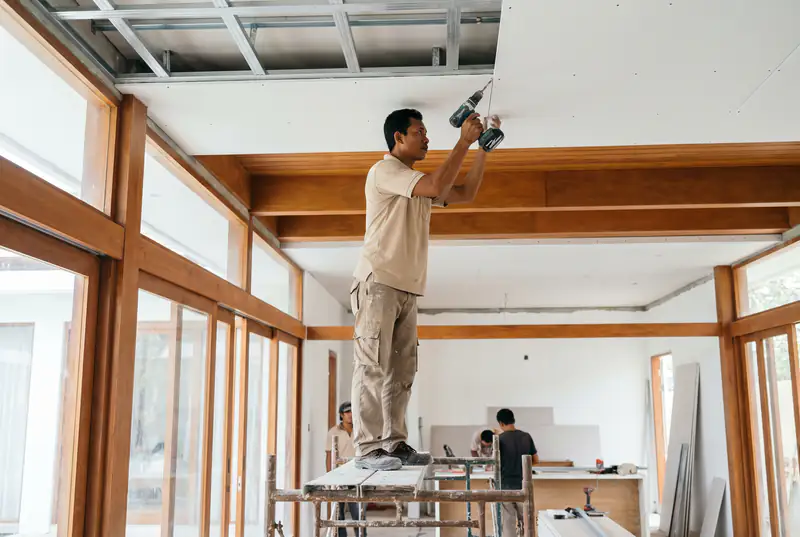
Flat gypsum ceilings, crisp shadow gaps and cove light that washes evenly — hung on galvanised metal framing, taped and skimmed properly, and painted by the same crew that built them. Flat ceilings from IDR 260,000/m², leak repairs from IDR 540,000 per patch.
Site visit at no cost · Itemised quote within 24h · from IDR 260,000/m²
What’s included
What you get with ceiling works
Layout & services plan
Ceiling heights, AC positions, downlights and access hatches drawn and agreed with your electrician before the first channel goes up.
Galvanised metal framing
Hollow-section grid at 60 cm centres with proper hangers — not timber battens left for the termites and humidity to argue over.
Quality gypsum boards
9 mm Aplus board in living spaces; moisture-resistant board over bathrooms, outdoor eaves and anywhere a roof might one day disagree with the rain.
Taping & jointing
Paper-taped joints with three compound passes and spotted screw heads — the difference between a ceiling and a map of every joint in raking light.
Skim & paint finish
Full skim, sanding and ceiling-grade matt paint — handed over as a finished ceiling, not a “ready for others” excuse.
Details that lift the room
Shadow gaps, LED cove boxes, bulkheads and curtain pelmets built dead straight, because light strips forgive nothing.
What a Bali ceiling should be built from
The ceilings that sag, stain and crack across this island share the same anatomy: timber battens the humidity warped and termites finished, boards butted without staggering, joints filled with compound but no tape. We build the other way — galvanised hollow-section framing on a 60 cm grid with proper hangers, 9 mm Aplus gypsum board screwed off to spec, and every joint paper-taped in three passes. The target is the same as our walls: flat to 2–3 mm over 2 metres, checked with a lamp, in villas from Berawa to family homes in Kerobokan.
Board thickness and screw spacing sound like trivia until the first monsoon. Nine-millimetre board on a 60 cm grid, screws at 15 cm along joints and 20 cm in the field, is the spec that stays flat while humidity swings 30% between noon and midnight. We also stagger board ends across the frame — a detail invisible on day one and the whole reason the joints are still invisible in year three. If you’re comparing quotes, ask every crew for exactly these numbers; the silence that follows is usually informative.
Moisture is the design constraint
A ceiling in Bali lives between two humid air masses, and near the coast — Jimbaran’s salt air is merciless — cheap frame sections corrode inside a couple of years. So the spec changes by room, not by habit: moisture-resistant board over bathrooms and under roof valleys, ventilation for the plenum instead of sealing damp air inside, galvanised framing everywhere. And one firm rule we won’t bend: we repair leak damage only after the roof is fixed. Replacing board under a live leak is selling you the same repair twice, and we’d rather keep you as a client.
Cove light, shadow gaps and boxes
Most of what people love about a “designer” Bali interior is ceiling detail: an LED cove washing the wall, a shadow gap instead of cornice, a clean bulkhead over the kitchen line. These live or die on straightness — a light strip in a wavy cove shows every millimetre. We build drop boxes and coves from IDR 280,000 per linear metre, laser-set, with the strip position mocked up before boarding. In an Umalas renovation last dry season, the cove lighting did more for the living room than the furniture budget did.
Ceiling repairs after roof leaks
Every November the same calls start: a brown ring spreading over the living room, a board bellying under the valley gutter, water dripping from a downlight. Our order of work doesn’t change with the season. First the roof gets fixed — we don’t re-board under a live leak. Then we open the ceiling at the stain, let the void dry out, check the frame for rust and cut out every board that has gone soft. New moisture-resistant board goes in, joints are taped in three passes, and the repair is skimmed and repainted edge to edge, so the patch doesn’t show in the afternoon light. A typical leak-damage repair starts from IDR 540,000 per patch.
Not every mark needs new board. Dry stains get sealed with a stain-blocker before repainting; sags mean framing at the wrong centres, so we re-hang rather than patch; cracked joints get raked out, taped and re-skimmed. Repairs finish with a blended repaint by our painting crew. When several rooms are hit after a wet season, we schedule them one room at a time, so the villa stays usable while we work.
Cost, sequence and one-crew finishing
Flat gypsum ceilings from IDR 260,000/m², moisture-resistant areas from 320,000, details per linear metre — the price table below and the pricing page carry the detail. In a full fit-out, ceilings go in after render cures and before walls get their final skim coat, so wall and ceiling planes meet in one crisp line. That sequencing is exactly why clients who start with one ceiling often hand us the whole finishing package — one crew means the joint between trades is never someone else’s problem.
Pricing
Gypsum ceiling prices per m²
| Work | Unit | Price (IDR) |
|---|---|---|
| Gypsum ceiling on metal frame, flat | per m² | from 260,000 |
| Moisture-resistant board (bathrooms, eaves) | per m² | from 320,000 |
| Multi-level ceiling: drop boxes & bulkheads | per lm of step | from 280,000 |
| Cove lighting trough, LED-ready | per lm | from 280,000 |
| Ceiling skim & repaint only | per m² | from 135,000 |
| Roof-leak damage repair (cut out, re-board, blend) | per patch | from 540,000 |
| Access hatches supplied & fitted | per piece | from 420,000 |
Labour + materials, October 2026, for ceilings up to 3.5 m. Vaulted spaces, deep coves and hotel corridors are quoted from drawings or a site visit — and we repair ceilings only after you’ve repaired the leak. Full price list on the pricing page.
All prices are approximate and do not constitute a public offer — the exact price is fixed in your written quote after a free site visit.
Wall or floor area and a few photos on WhatsApp are enough; the fixed quote follows the free site visit.
Related
Often ordered together
FAQ
Ceiling works in Bali — FAQ
Gypsum, PVC or GRC — what’s right for Bali?
Gypsum for interiors: it takes skim and paint, so it’s the only option that looks like architecture rather than cladding, and it’s repairable. Moisture-resistant gypsum for bathrooms with decent ventilation. GRC or fibre-cement outside on exposed eaves. PVC panels are cheap and fast — and look exactly that; we fit them on request but won’t pretend.
Will the joints crack later?
Joints crack when framing is sparse, boards meet without staggering, or compound goes on without tape. Our grid runs 60 cm centres, joints are paper-taped in three passes, and runs over 6 m get control joints. On that system, joint cracking is rare enough that we cover it under the same warranty as our plaster.
Can you repair a water-stained ceiling?
Yes — after the leak is fixed, and we can help find it. We cut back to sound board, re-frame locally if the metal corroded, re-board, tape and skim, then stain-block and repaint the full panel or ceiling so the sheen stays even. Painting over a brown ring without sealing it means it returns in weeks.
Do you coordinate downlights and AC with the electrician?
Always — the layout is agreed on paper before boarding, we frame openings and boxes to it, the electrician pulls cable and mounts fittings, and we close up after testing. Most ugly ceilings in Bali are trade-sequence failures, not craftsmanship failures; ours are sequenced.
How long does a ceiling take?
A typical 100 m² villa runs 8–10 working days from framing to final paint, including compound drying time. Single-room leak repairs are usually 1–3 days plus drying. You get the schedule in writing before we start — same as every trade we run under turnkey finishing.
Get a free site visit and a fixed quote
Send us a photo of your walls or your floor plan on WhatsApp. We visit the site, measure everything and send an itemised quote — usually within 24 hours. No obligation.