Microcement in Bali: floors, bathroom walls and polished concrete
Microcement and polished concrete for villa floors, bathrooms and feature walls — laid by our own crew over a laser-levelled base, sealed for Bali humidity, with real drying times in the written schedule. Polished concrete from IDR 350,000/m², microcement from 850,000/m².
Free site visit with sample boards · Itemised quote within 24h · 24-month workmanship warranty
What’s included
What you get with a microcement or polished concrete floor
Laser level survey
Every room shot with a laser and datum marks on the walls — you see the actual highs and lows before we quote thickness, not after.
Substrate preparation
Slab vacuumed, cracks addressed, bonding slurry or primer applied — so the screed becomes part of the floor, not a loose biscuit on top of it.
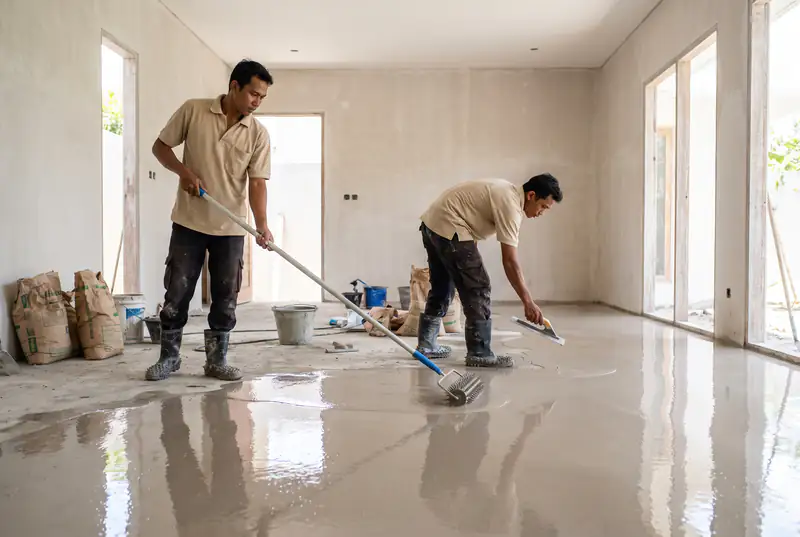
Sand-cement screed
30–50 mm screed laid to level, or to falls in wet areas and terraces, fibre-reinforced where spans and loads ask for it.
Self-levelling top coat
Mortar Utama or Drymix self-levelling compound at 3–10 mm where large-format tile, vinyl or microcement demands near-zero deviation.
Moisture testing
Residual moisture measured before any covering goes down — the unglamorous check that saves timber floors and adhesive warranties.
Finish options
Power-trowelled surface, polished concrete with densifier and sealer, or jointless microcement — specified per room and per budget.
Microcement or polished concrete: which floor suits your villa
Polished concrete is Bali’s favourite café floor for a reason, and Pererenan seems to open a new one monthly. Done properly it’s a process, not a paint: diamond grinding through 4–5 grit stages, a densifier to harden the surface, then a penetrating sealer — from IDR 350,000/m² on a suitable slab. Microcement, from 850,000/m², is the jointless alternative that goes over existing screeds and upstairs floors, and pairs with the same finish on walls and showers for the one-material bathrooms every designer currently draws.
Microcement bathrooms and walls
Microcement is a 2–3 mm mineral coating, so it goes where a slab can’t: shower walls, vanity walls, stairs, upstairs floors and straight over sound old tile once it is primed and meshed. In a bathroom that gives one continuous surface from floor to ceiling — no grout lines, which in Bali are the first place mould settles. It pairs with our decorative wall finishes when a designer wants the shower and the bedroom wall to read as one material.
A wet area is only as good as what sits behind it. Before any microcement goes into a shower we screed the floor to falls toward the drain, apply a waterproofing membrane up the walls and across the floor, and let both cure; the finish then gets a sealer rated for wet areas. Living floors get a matt or satin sealer instead, and you keep a labelled reserve of your exact colour for touch-ups. Prices per m², labour and materials:
| Surface | What’s included | Price (IDR/m²) |
|---|---|---|
| Microcement floor | primer, mesh, microcement coats, sealer | from 850,000 |
| Microcement walls & vanity walls | primer, mesh, microcement coats, sealer | from 750,000 |
| Microcement shower (walls + floor) | waterproofing membrane (from 200,000) + wall microcement (from 750,000) | from 950,000 |
| Polished concrete floor | grinding in 4–5 grit stages, densifier, sealer | from 350,000 |
| Base: sand-cement screed / self-levelling | laser-levelled, to falls in wet areas | from 165,000 / 200,000 |
Guide rates from our October 2026 price list; the exact price is fixed after a free site visit, where we bring sample boards of each finish.
Pick a finish from our sample boards — tap one and WhatsApp opens with the finish already named in the message:
Why Bali floors fail before the walls do
Hollow-sounding tiles in a two-year-old Canggu villa, lippage you can catch a toe on in a Denpasar shophouse, cracks wandering across a Nusa Dua apartment floor — nearly all of it traces back to the screed. The usual sins: mortar mixed too dry so it never bonded, no primer or slurry on a dusty slab, and coverings installed days after the pour because the schedule said so. The screed is the least visible layer in the whole house and the most expensive one to redo, since everything above it comes up too.
There’s a quiet economics problem underneath: screed is priced low and bid lower, so crews make their margin back on speed — pour fast, skip the primer, cover early. We price it honestly from IDR 165,000/m² and treat it as structure, because it is: the screed carries your furniture, your tile adhesive warranty and the flatness of everything you’ll ever put on it. A cracked wall can be repaired over a weekend; a failed screed under a tiled living room is demolition. That asymmetry is why we’d rather lose a bid than pour a floor we wouldn’t cover ourselves.
The base under the finish: screed, self-levelling, or both
The laser survey decides the build-up, not habit. Where a slab is 30–60 mm out across a room — common — a sand-cement screed from IDR 165,000/m² restores a true level and sets falls in wet areas. Where the finish is unforgiving (microcement, vinyl, 1.2-metre porcelain), we add a self-levelling pour from 200,000/m² using Mortar Utama or Drymix compounds at 3–10 mm. On decent slabs the self-leveller alone does the job, and you save the thickness, the weight and the drying weeks of a full screed.
Drying times nobody wants to hear
Here’s the conversation other crews avoid: a 40 mm screed wants roughly four weeks before moisture-sensitive coverings in dry season — longer in January, when the air gives moisture nowhere to go. Tiles tolerate more, timber forgives nothing. We put the real numbers in the written schedule, then verify with a moisture meter before covering instead of arguing with physics. When a client’s tiler in Umalas was told “three days is fine” by the previous crew, the re-tiling cost more than our entire screed had.
Sequencing, protection and price
In a full fit-out, floors go in after ceilings and wall skim but before final paint — the order we run on every turnkey project, so trades stop destroying each other’s work. Finished floors get board protection until handover, not a plastic sheet and a prayer. Budget-wise: screed from 165,000, self-leveller from 200,000, polished concrete from 350,000, microcement from 850,000 per m² — the pricing page shows how that sits in a whole-villa budget, and the laser survey that fixes your exact number is free.
Pricing
Microcement and polished concrete prices per m²
| Work | Unit | Price (IDR) |
|---|---|---|
| Sand-cement screed (30–50 mm) | per m² | from 165,000 |
| Self-levelling compound (3–10 mm) | per m² | from 200,000 |
| Polished concrete (grind, densify, seal) | per m² | from 350,000 |
| Microcement floor system | per m² | from 850,000 |
| Waterproofing under wet areas | per m² | from 200,000 |
| Screed repair / partial re-pour | per m² | from 240,000 |
Labour + materials, October 2026. Rates assume ground-floor access and standard thickness; upper floors, pumping and falls to drains are quoted after the laser survey. Full price list on the pricing page.
All prices are approximate and do not constitute a public offer — the exact price is fixed in your written quote after a free site visit.
Wall or floor area and a few photos on WhatsApp are enough; the fixed quote follows the free site visit.
Related
Often ordered together
FAQ
Microcement & polished concrete floors — FAQ
How flat will the floor actually be?
Standard screed we hand over at 3 mm or better under a 2-metre straightedge — fine for tile and engineered timber. Microcement, vinyl and large-format porcelain want tighter, which is what the self-levelling top coat is for. At handover you get the straightedge in your own hands, same as our walls.
How long before tiling or timber can go down?
Tiles: usually 7–10 days on a standard screed. Timber, vinyl and microcement wait for moisture readings, not the calendar — roughly a week per centimetre of thickness in dry season, noticeably longer in wet. Anyone promising timber on a week-old 50 mm screed is selling you cupped boards.
Polished concrete or microcement — which one?
Polished concrete (from 350,000/m²) needs a decent slab or new screed, suits ground floors, and gives the raw, stone-like look. Microcement (from 850,000/m²) is a 2–3 mm system over any sound screed — upstairs, bathrooms, over old tile — with far more colour control. Both get sealed against staining; we bring samples of each to the site visit.
Can you fix hollow tiles or a cracked screed?
Yes — we tap-map the floor, cut out the failed zones, re-pour with a bonding slurry and match levels to the surviving floor. Hairline crazing is usually cosmetic; cracks that mirror through tile in straight lines mean the screed debonded or was poured too dry, and patching over them just moves the crack.
Do you do falls to floor drains?
Bathrooms, outdoor showers and terraces are screeded to falls — typically 1–2% toward the drain — over a waterproofing layer, before any tile, stone or microcement. Water that stands on a flat wet-room floor in this climate always finds a way down; we make sure it’s the drain.
Is microcement cheaper than tiles?
Per m² it usually isn’t: microcement starts from IDR 850,000/m² on floors and 750,000/m² on walls, which is a premium finish. The saving appears when it goes over existing sound tiles — no demolition, no new screed, no weeks of drying — and in bathrooms, where there are no grout lines to re-seal or re-grout later.
Can microcement go in a shower?
Yes, as a system: floor screeded to falls, waterproofing membrane behind walls and floor, then microcement and a sealer rated for wet areas. From IDR 950,000/m² for walls plus membrane. Without the membrane we don’t install it in showers.
Get a free site visit and a fixed quote
Send us a photo of your walls or your floor plan on WhatsApp. We visit the site, measure everything and send an itemised quote — usually within 24 hours. No obligation.