Cement render and acian in Bali by our own crew
Cement render (plesteran) and acian skim on brick or AAC block, from IDR 160,000/m² with materials. Our own crew renders walls flat to 2–3 mm over 2 metres, lets them cure 10–14 days before skim and hands them over checked with a straightedge — with a 24-month workmanship warranty.
Site visit at no cost · Itemised quote within 24h · from IDR 160,000/m²
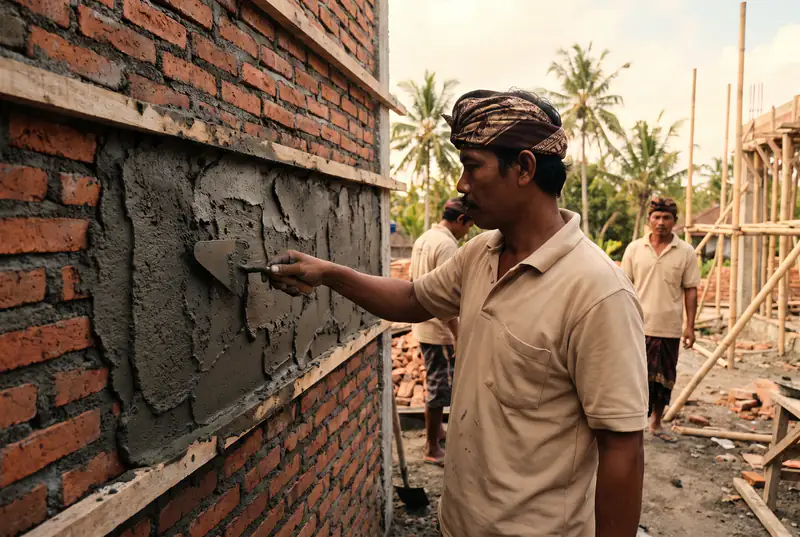
What’s included
What you get with cement render and acian
Surface preparation
Brick and AAC block walls brushed, dampened and checked for hollow spots; old loose plaster cut back to solid material before anything new goes on.
Screed rails & levelling
Kepalaan guide rails set with a laser so the render plane is straight — corners square, window reveals even, no “wavy wall at sunset” effect.
Cement render (plesteran)
15–20 mm render in controlled passes using Mortar Utama or Drymix mixes — not hand-mixed sand of unknown origin from the nearest river.
Curing management
Render kept damp and left to rest 10–14 days depending on season. This is the step cheap crews skip, and the reason their walls crack by February.
Acian skim finish
Fine cement skim trowelled to a hard, smooth surface — flat to 2–3 mm over a 2-metre straightedge, ready for putty and paint.
Straightedge handover
You walk the walls with our level and raking lamp before final payment. Anything off gets fixed on our time, not yours.
Why plastering is where Bali builds go wrong
Walk into any villa handover in Canggu or Berawa and run a 2-metre straightedge along the living-room wall. More often than not you’ll find 5–10 mm waves, hairline cracks over the conduit chases and corners that were never square. None of that is bad luck — it’s what happens when render is mixed by eye, slapped on in one thick coat and painted five days later.
We’ve spent years fixing exactly these walls, so our process is built around the three things that actually matter in a tropical climate: straight planes (laser-set guide rails before the first trowel of mortar), controlled thickness (two passes with mesh where needed instead of one heavy coat), and real curing time (render rests 10–14 days before the acian skim goes on — non-negotiable, even when the deadline is loud).
What “flat” means when we say it
Our standard is 2–3 mm of deviation over a 2-metre straightedge — roughly the tolerance of a factory-made panel. At handover we check every wall with you: straightedge, inspection lamp held at a raking angle, and a pencil for marking anything that needs another pass. Walls in direct low sun (west-facing living rooms in Seminyak get brutal 5 pm light) get an extra sanding-lamp check, because that’s where waves show first.
Materials we trust in Bali’s humidity
For render we work with Mortar Utama (MU-301/100) and Drymix systems — factory-blended mixes with predictable shrinkage, instead of site-mixed sand that may or may not have been washed. Acian is MU-200 or equivalent, trowelled hard. For walls with a history of damp — common in Umalas garden walls and Ubud bedrooms that back onto the jungle — we add a waterproof slurry coat or switch to a breathable lime system and tell you why in plain language.
New builds, renovations and “please fix what they did”
About half our plastering work is new construction: villa shells in Pererenan and Canggu where we come in after the electrician and plumber finish their chases. The other half is renovation — old Sanur family homes with 20-year-old plaster, water-stained walls in Kerobokan guesthouses, or brand-new builds where the previous crew’s render is already cracking. For renovations we always tap-test and moisture-check first: sometimes you only need crack repair and a fresh skim coat, and we’d rather quote you the smaller job than sell you a re-plaster you don’t need.
How the numbers work
Plastering in Bali is priced per square metre of wall, and the honest range in 2026 is wider than most owners expect — IDR 115,000 for simple render up to IDR 240,000+ where old plaster has to come off first. Height matters (scaffolding above 3.5 m), access matters (a clifftop site in Uluwatu is not a roadside shop in Denpasar), and wall condition matters most of all. That’s why we quote only after measuring — and why the quote you get is itemised down to the primer brand. For the full picture with worked examples, read the 2026 wall plastering cost guide.
Pricing
Render and acian prices per m²
| Work | Unit | Price (IDR) |
|---|---|---|
| Cement render + acian (new brick/AAC walls) | per m² | from 160,000 |
| Render only (plesteran, 15–20 mm) | per m² | from 115,000 |
| Acian skim over existing render | per m² | from 70,000 |
| Re-plastering (old plaster removed first) | per m² | from 240,000 |
| External walls / parapets (scaffolding incl.) | per m² | from 195,000 |
| Ceiling render | per m² | from 210,000 |
Labour + standard materials, October 2026. Final rate depends on wall condition, height and access — fixed after a free site visit. Full price list on the pricing page.
All prices are approximate and do not constitute a public offer — the exact price is fixed in your written quote after a free site visit.
Wall or floor area and a few photos on WhatsApp are enough; the fixed quote follows the free site visit.
Related
Often ordered together
FAQ
Cement render & acian — FAQ
How thick should wall plaster be in Bali?
Standard render is 15–20 mm: enough to straighten typical brickwork without adding weight the wall doesn’t need. Where walls are badly out of plumb we render in two passes with mesh rather than one thick coat — thick single coats slump and crack in tropical heat.
How long must render cure before skim and paint?
We hold 10–14 days between render and acian, and another 14+ days before paint in wet season. Moisture trapped under paint is the #1 cause of peeling in Bali. If a crew promises brick-to-paint in one week, that is exactly the corner they are cutting — we explain why in our guide to cracking walls →
Can you plaster over old painted walls?
Not directly — new plaster doesn’t bond to paint. We either strip back to solid render and re-skim, or mechanically key the surface and use a bonding agent. On a site visit we tap-test the old plaster: if large areas sound hollow, honest advice is re-plastering, and we quote both options.
Do you plaster in the rainy season?
Interior work — yes, year-round. Exterior render we schedule around the rain and always protect fresh walls with sheeting; what changes most is curing time, which we extend rather than compress. The schedule you get already accounts for the season.
Is your price per m² fixed after the quote?
Yes. We measure every wall on the site visit, so the quote lists exact areas and named materials. The only thing that changes the price afterwards is you changing the scope — hidden-condition surprises are our risk, not yours.
Get a free site visit and a fixed quote
Send us a photo of your walls or your floor plan on WhatsApp. We visit the site, measure everything and send an itemised quote — usually within 24 hours. No obligation.