How to Choose a Plastering Crew in Bali: 12 Questions to Ask
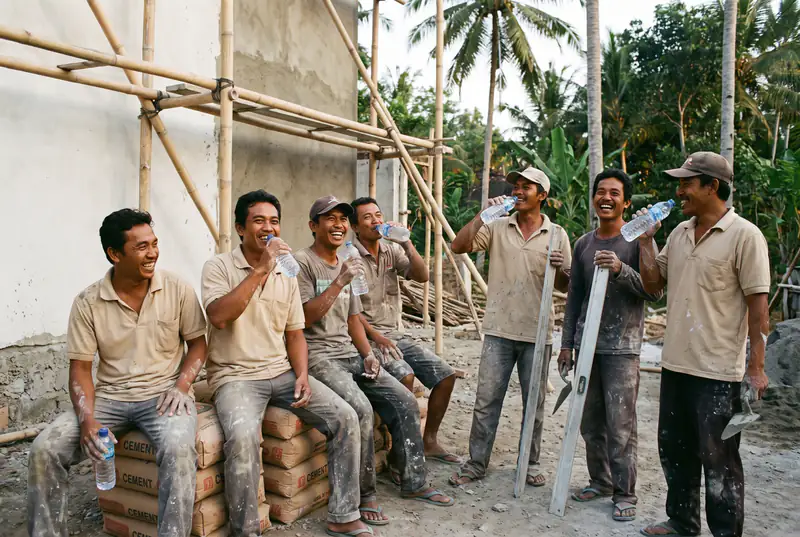
Every finishing disaster we’ve been hired to rescue — the wavy Canggu walls, the Jimbaran villa painted five days after rendering, the crew that vanished at 70% paid — could have been prevented by a fifteen-minute conversation before anyone was hired. Owners compare quotes; almost nobody interrogates them. Here are the twelve questions we’d ask any plastering or finishing contractor in Bali — including us — plus the red flags, the math of cheap work, and what an honest quote actually looks like on paper.
First, the framing question: day rate or per m²?
Question 1: “Do you price per day or per square metre?” This single answer sorts crews into two economic universes. A day-rate crew (IDR 150,000–300,000 per worker per day) earns more the longer your job takes — you carry all the schedule risk, and “two more weeks, boss” costs them nothing. A per-m² crew earns the same whether the wall takes eight days or eleven, so speed and organisation work for you, not against you. Day rates make sense for genuinely undefined work — demolition surprises, odd repairs. For measurable surfaces they’re a slow leak. If a contractor only works day-rate and can’t translate your project into m² numbers, they’ve never had to stand behind a fixed price — which tells you how disputes will go later.
The 12-question checklist
With question 1 asked, here are the remaining eleven, in the order that saves you the most money:
- 2. “Who exactly will be on my site?” A crew that works together permanently, or a broker who collects day labourers after winning your job? Brokers quote fast and staff whoever’s free; the skill level of “their” plasterers changes weekly. Ask whether the foreman is employed or hired per project — and whether he’ll be there daily.
- 3. “Which material brands are in this quote?” “Semen dan pasir” is not an answer. You want named products: Mortar Utama or Drymix render, A-Plus putty, Dulux or Jotun paint with the product line specified. Unnamed materials become the cheapest bag in the shop the morning they’re bought.
- 4. “How many days of curing do you allow for the render?” The correct answer involves real numbers — misted curing for 3+ days, a week or more before skim and paint. The wrong answer is a wave of the hand. Skipped curing is the single biggest reason Bali walls crack, and crews that compress it are pricing in your future repairs.
- 5. “Can I put a straightedge on your last project?” More on this test below — the question alone is diagnostic. Confident crews say yes immediately.
- 6. “Give me photos and addresses of your three most recent jobs.” Recent, not best-of-decade. Any working crew finished something last month. Cross-check one address if you can — in Pererenan or Sanur it’s a ten-minute detour that has saved owners tens of millions.
- 7. “Will you put the schedule in writing?” Start date, sequence, milestones, end date. Verbal schedules in Bali have the lifespan of a mango. A crew that won’t write dates down is keeping its options open — with your project.
- 8. “What exactly is included in the price?” Primer? Sanding? Scaffolding? Masking? Corner beads? The classic trap: a low per-m² rate that excludes primer and sanding, which reappear mid-job as “extras” you can’t refuse. Every exclusion belongs on paper before you compare any two quotes.
- 9. “What warranty, in writing, covering what?” Ours is 24 months on workmanship — cracks from our plaster, delamination, paint failure. Ask what triggers a free fix versus a paid visit. “We always come back, no problem” without paper means the warranty expires when the phone number changes.
- 10. “Who cleans the site, and when?” Small question, perfect predictor. Crews that plan daily cleanup and debris removal plan everything else too. Crews that leave a sand mountain in your carport for a month were improvising all along.
- 11. “What deposit do you need?” 30–40% for materials is standard and fair. 50% is negotiable with reasons. 70%+ is a red flag with its own section below — and 100% upfront is how owners end up hiring us to finish someone else’s job.
- 12. Listen for “bisa, bisa.” “Can you do Venetian?” Bisa. “Three weeks?” Bisa. “This budget?” Bisa. Enthusiasm without numbers is not capability — it’s a sales reflex. Every real “bisa” can be converted into a rate, a brand and a date on paper. If it can’t, it was a “no” wearing a smile.
The 30-second straightedge test
Words aside, plastering quality is measurable, and the tool costs IDR 300,000. Take a 2 m aluminium straightedge (or a long level) to any wall the crew finished. Hold it against the surface horizontally, vertically, diagonally; do it near a window where light rakes across the wall. Gaps under the edge of 2–3 mm over two metres are acceptable trade standard; 5 mm bellies and hollows mean the render was never rodded flat, and no amount of paint will hide it at 4 pm when the sun comes through. While you’re there, sight down the wall from the corner, check that window reveals are equal width top to bottom, and run your palm across a skimmed area — it should feel like paper, not orange peel. Thirty seconds, no expertise required, and it filters crews better than any conversation. It’s also, frankly, why crews who rod their render flat — like ours — keep suggesting the test to prospective clients.
Red flags that should end the conversation
Any one of these is survivable with luck; two or more, walk away. A price far below everyone else’s — someone is paying the difference, and it’s you, later. No named materials in the quote. “No need for a contract, we’re like family.” Family doesn’t re-skim your walls for free either. 70%+ deposit before a bag of cement arrives. Pressure to decide today because “another project is waiting” — real crews are booked, not desperate. No fixed foreman, or a different phone number answering each time. Refusal of the straightedge test or vagueness about recent addresses. And the subtle one: a quote in “lump sum” with no m² breakdown, which makes overbilling invisible and comparison impossible. None of these mean bad people — they mean a process that will fail you, politely.
Why the cheap crew is the expensive crew: the redo math
Here’s the arithmetic we walk owners through after the fact, with real 2026 rates from our cost guide. A proper skim-and-paint package runs about IDR 170,000/m² (75,000 skim + 95,000 paint, materials named, curing respected). The tempting quote is 90,000/m² all-in. Six months later the cheap version delivers: powdering skim, paint peeling at the tape lines, waves in every afternoon shadow. The repair is not “paint again”: failed skim must be stripped (≈ IDR 35,000/m² of slow, dusty labour), re-skimmed (75,000), and repainted (95,000) — about 205,000/m² of rework, on top of the 90,000 already spent. Total: IDR 295,000/m² for walls that could have cost 170,000 — about 1.7× the price of doing it once, properly, before counting weeks of disruption and the furniture you moved twice. The cheap quote isn’t a price; it’s a loan at 100% interest, and the wall always collects.
What a proper quote looks like
Not a number in a WhatsApp message — a document. The lines below are the shape of an honest finishing quote in Bali:
| Quote line | Qty | Rate (IDR) | Line total |
|---|---|---|---|
| Render + acian, internal walls — MU-301 / MU-200 | 240 m² | 160,000/m² | 38,400,000 |
| Skim coating, 2 coats A-Plus, sanded | 240 m² | 75,000/m² | 18,000,000 |
| Painting: primer + 2× Dulux Catylac | 240 m² | 95,000/m² | 22,800,000 |
| Scaffolding, masking, daily cleanup, debris removal | — | included | 0 |
| Total · 24-month written warranty · 21 working days | 79,200,000 |
Note what the format forces: measurable quantities you can verify with a tape measure, named brands you can check at the shop, inclusions stated instead of assumed, and a duration with a warranty attached. Payment terms sit under it — 35% on signing, 35% at render complete, 30% after your walk-through. When two quotes are both written like this, comparing them takes five minutes and zero faith. If you’d rather hand the whole coordination problem to one accountable team — plaster through paint, floors and ceilings included — that’s exactly what our turnkey finishing service exists for.
Use the list — including on us
Print the twelve questions and ask them of every crew you meet, whether the project is a renovation in Uluwatu or a new build in Canggu. Good contractors enjoy answering them; the questions do the filtering before your money does. And we mean it about including us: ask for our recent addresses, put a straightedge on our walls, read the warranty terms line by line. Our answers are on the about page, and the fastest way to test them is to request a quote and see whether the document that arrives matches everything this article told you to demand.