Wall Plastering & Finishing in Ubud
Ubud’s walls fight a different war — jungle humidity that never lets surfaces dry, deep shade, and mould that returns every wet season. We finish walls here with breathable lime systems and honest advice about what survives the ridge and what does not.
Free site visit in Ubud with sample boards · Own crew of 12, no subcontractors
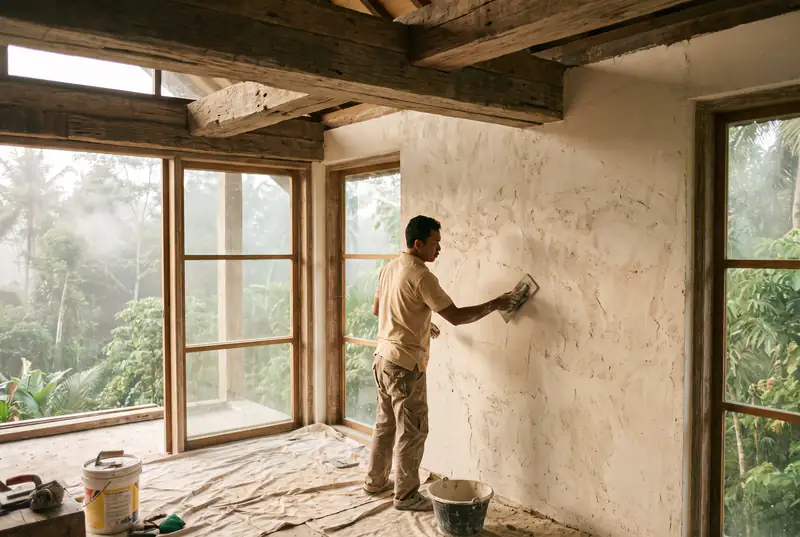
Why cement-and-paint fails on the ridge
The standard Bali wall — cement render, acian, acrylic paint — is a sealed system, and sealed systems suffer in Ubud. Jungle humidity pushes moisture through walls from the shaded side; sealed paint traps it, and the result is the Ubud classic: blisters, black mould in the corners, paint peeling in sheets by the second wet season. Around Penestanan, along the Campuhan ridge and in the valleys off Monkey Forest Road we have stripped walls that were repainted four times in six years — every repaint a bandage on the same wound.
The cure is to let the wall breathe. Lime plaster stays vapour-open: moisture passes through and evaporates instead of pooling behind a plastic film. It is also naturally alkaline, which mould hates. It costs more and cures slower than cement — and it is the only system we are happy to stand behind in deep jungle shade. The paint layer matters as much as the plaster: silicate and lime paints stay breathable, while one coat of ordinary acrylic rolled on top quietly re-seals the wall and undoes the whole system.
How we build a breathable wall
An Ubud lime job runs slower by design: lime-compatible base coats, thin finishing passes and real curing days between them — rushed lime turns into a chalky surface that powders off under a hand. Where the budget cannot stretch to full lime, we are honest about the middle path: mould treatment, breathable mineral paints over existing render and ventilation advice for the rooms that never see sun. Guesthouses get a phased plan — one wing at a time through the drier months, so rooms keep selling while the walls change system. What we will not do is quietly roll standard acrylic over a damp wall and let the wet season expose it. Standard system prices are on the pricing page; lime systems we quote per project after reading the walls.
Jungle houses, timber bones
Ubud architecture loves mixing masonry with timber and bamboo — beautiful, and a crack factory when finished naively, because timber moves with humidity and masonry does not. Where a plastered wall meets a timber post we never bridge the joint rigidly: mesh reinforcement, a flexible sealant joint or a clean expressed shadow gap, depending on the detail. That is the difference between a hairline at every junction by next August and a wall that stays quiet. The physics is in our guide to why walls crack, and the crack repair page covers the ones you already have.
We drive up for Ubud projects weekly, often pairing them with work in Sanur or Denpasar. The coastal pages — Canggu and its neighbours — describe a different Bali; up here, humidity writes the specification.
Services in Ubud
What we do in Ubud
Nearby
Also working in
FAQ
Plastering in Ubud — FAQ
The mould keeps coming back — can you actually fix it?
Repainting over mould is cosmetic; it returns because moisture stays in the wall. We fix the path instead: treat the spores, switch to breathable plaster and paint so the wall dries through, and flag the rooms that also need ventilation. In deep jungle shade the honest answer is a maintenance rhythm — but years apart instead of months.
What does lime plaster cost compared to normal render?
Cement render + acian starts from IDR 160,000/m²; breathable lime systems typically run 1.5–2× that, because materials cost more and application is slower. We quote both options after seeing the walls, with our recommendation in writing — baseline rates are on the pricing page.
Can you plaster in Ubud during the wet season?
Interiors, yes — all year. Exteriors we schedule around rain windows, and everything cures slower at 90% humidity, so an Ubud schedule is honest about drying days rather than pretending they do not exist. Rushing cure times is exactly how walls fail up here.
Our walls crack where they meet timber posts — is that normal?
Very normal, and fixable. Timber moves with humidity and masonry does not; a rigid plaster bridge across that joint will always crack. We repair with mesh reinforcement or a flexible joint — the mechanics are in why walls crack in Bali.
Request a free quote in Ubud
Send a photo of your walls or floor plan on WhatsApp — we are in Ubud regularly and can usually visit within a day or two — and we bring sample boards of render, limewash, Venetian and microcement finishes to the visit.