Venetian Plaster & Decorative Finishes in Bali
Venetian polish, limewash, tadelakt-style and microcement — mineral finishes with real depth, specified for tropical humidity and applied by finishers who’ve burnished more walls than mood boards.
Site visit at no cost · Itemised quote within 24h · from IDR 650,000/m²
What’s included
What you get with venetian & decorative plaster
Design consult & samples
We review your references, then make A3 sample boards and a test patch on your actual wall — colour and sheen judged in your light, not a showroom’s.
Substrate preparation
Feature walls get skimmed to a near-perfect plane and sealed with mineral primer; decorative plaster forgives nothing underneath.
Layered application
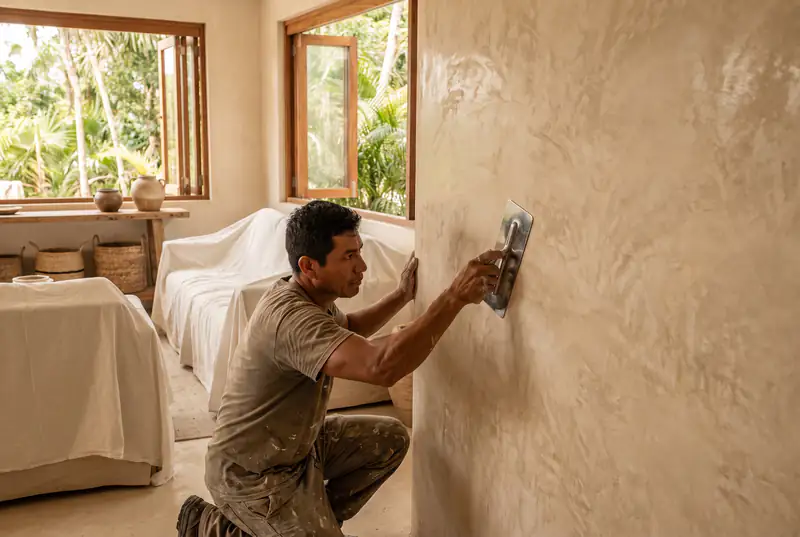
Two to four coats by steel trowel depending on the system — thin, tight passes that build the depth these finishes are famous for.
Burnishing & polishing
Venetian surfaces polished to the agreed sheen, from soft eggshell to near-mirror; textured finishes tooled while the material is still live.
Humidity-rated sealing
Wax, matt mineral sealer or soap finish depending on the room — bathrooms and outdoor walls get systems that breathe or repel, never trap.
Care guide & touch-up batch
Written care instructions plus a labelled reserve of your exact mix — pigmented plaster can’t be colour-matched later from memory.
The finishes on every Bali mood board
Open the design file for any new boutique hotel in Seminyak or a jungle villa above Ubud and you’ll find the same references: clay-toned limewash, polished venetian walls catching the afternoon sun, jointless microcement bathrooms. Architects specify these finishes because flat paint has no depth — mineral plaster shifts with the light all day, which is precisely what tropical architecture is built around. We apply them for designers, owners and builders across the island, from single feature walls in Pererenan new builds to full spa interiors.
Real lime and mineral systems, not effect paint
There are two ways to sell “venetian plaster” in Bali. One is an acrylic paint with a venetian-effect roller technique — cheap, plastic-looking, and the source of most horror stories. The other is what we do: slaked lime and marble dust built up in thin trowelled layers, plus factory mineral systems from Kerakoll where a project needs certified consistency. Mineral finishes are high-pH, so they resist mould naturally, and they breathe — moisture moves through the wall instead of blistering the finish off it.
Limewash deserves a special word, because it’s the budget hero of the group. From IDR 280,000/m² it delivers the soft, cloudy movement that flat paint imitates with sponge tricks and never quite reaches — and it works across whole rooms, not just one showcase wall. We brush it in two or three passes over a mineral base coat, so the pigment sits inside the surface rather than on top of it; it ages by softening, not by peeling. For renovated joglos and the lime-loving interiors going up around Ubud, it’s usually the first sample board we make.
Humidity decides the spec
Every quote starts with one question: what does this room do? Living-room venetian gets a wax or matt mineral sealer that keeps breathability. Shower walls need the opposite — a soap-compressed tadelakt-style surface or microcement with a waterproof membrane behind it. Exterior limewash stays fully breathable, which is why it outlives film-forming paint on salt-air sites in Uluwatu. Specify a finish against the wrong room and Bali will find it out within one wet season; that mistake is much more expensive than the consultation that prevents it.
The invisible half of the job is underneath
A polished wall is a mirror for everything below it. So the substrate gets treated like a finish in its own right: fully cured render and acian (we won’t trowel lime over green cement — the alkalinity and moisture wreck the pigment), a dead-flat skim coat, mineral primer, and any moving cracks repaired with mesh before we start. Roughly a third of a decorative quote is this preparation. Crews that skip it are the reason “venetian plaster Bali” has a mixed reputation.
What it costs and how to start
Honest 2026 ranges: limewash from IDR 280,000/m², textured minerals from 300,000, venetian polish from 650,000, tadelakt-style wet-area work from 1,200,000 and wall microcement from 750,000 — full context on the pricing page. The process starts small: send us your references and wall photos, we advise which system actually fits the room, then produce sample boards and an on-wall patch before you commit to anything. Finished walls are in the gallery — trowelled surfaces photograph honestly, which is exactly why we show them.
Tadelakt bathrooms and showers
Tadelakt is a Moroccan lime plaster that is compressed with a smooth stone and sealed with olive-oil black soap until the surface sheds water. It is the one decorative finish made for wet rooms, and in a Bali bathroom it gives what tiles can’t: curved walls, built-in niches and a shower that reads as one piece, without a single grout line for mould to settle in.
We apply it as a system, not as a coating. The shower floor is screeded to falls, a waterproofing membrane goes behind walls and floor, and the tadelakt is laid over a lime base, polished while still soft and soaped until the surface closes. Tadelakt-style wet-area work starts from IDR 1,200,000/m² — the price table below lists it next to microcement, the other jointless option for showers.
Honest limits: tadelakt needs care. Acidic cleaners etch lime, so we hand over a care sheet and the soap used for maintenance, and recommend a fresh soap coat in heavy-use showers once or twice a year. Where an owner wants a shower that needs nothing, we suggest microcement with a wet-area sealer instead.
Before we quote a tadelakt bathroom, we make a sample board in your colour and leave it in the room for a few days — lime looks different in morning light, under a downlight and when wet.
Pick a finish from our sample boards — tap one and WhatsApp opens with the finish already named in the message:
Pricing
How much does it cost in Bali
| Work | Unit | Price (IDR) |
|---|---|---|
| Venetian polished plaster (2–3 layers) | per m² | from 650,000 |
| Limewash / lime paint on mineral base | per m² | from 280,000 |
| Tadelakt-style waterproof finish (wet areas) | per m² | from 1,200,000 |
| Microcement on walls & showers | per m² | from 750,000 |
| Textured & rustic mineral finishes | per m² | from 300,000 |
| Sample boards + on-wall test patch | per project | from 750,000, credited |
Labour + mineral materials, October 2026. Decorative work is priced per wall after we see the light, the substrate and your references — never sight-unseen. The sample fee is credited when you book the job. Full price list on the pricing page.
All prices are approximate and do not constitute a public offer — the exact price is fixed in your written quote after a free site visit.
Wall or floor area and a few photos on WhatsApp are enough; the fixed quote follows the free site visit.
FAQ
Venetian & decorative plaster in Bali — FAQ
Does Venetian plaster survive Bali’s humidity?
Yes — real lime plaster is breathable and handles humidity better than acrylic paint, which is why it survives centuries in humid Italian coastal towns. The failures we get called to fix are almost always “venetian-effect” acrylic paint, not mineral plaster. The conditions: a cured, dry substrate and the right sealer for the room.
Venetian plaster or paint — how do I decide?
A polished-plaster wall costs 5–10× more per square metre than paint, so we rarely suggest it for whole houses — one to three walls where light hits is the sweet spot. Depth, durability and repairability are what you buy. We break the maths down in Venetian plaster vs paint.
Can you do just one feature wall?
Most of our decorative jobs are exactly that — a bedhead wall, a lobby wall, one bathroom. The minimum engagement is the sample stage plus one wall; sample cost is credited into the job. Small doesn’t mean casual: a single wall still gets substrate prep, layered application and sealing.
What about showers and bathrooms?
Wet areas get either a tadelakt-style soap-sealed lime finish or microcement, both built as waterproof systems rather than pretty coatings. We’re honest about terminology: authentic Moroccan tadelakt is its own craft, and what Bali needs is the same physics — lime, compression, soap — engineered for daily villa use. Floors to match live under floor finishing.
How do I maintain a decorative wall?
Soft cloth, pH-neutral soap, no abrasives or citrus cleaners on lime. Waxed venetian walls in living areas like a re-wax every 2–3 years — a one-visit job. We keep a record of your batch and pigment ratios, so a scratch five years from now is a repair, not a redo.
Get a free site visit and a fixed quote
Send us a photo of your walls or your floor plan on WhatsApp. We visit the site, measure everything and send an itemised quote — usually within 24 hours. No obligation.