Venetian Plaster vs Paint in Bali: Cost, Look and Durability
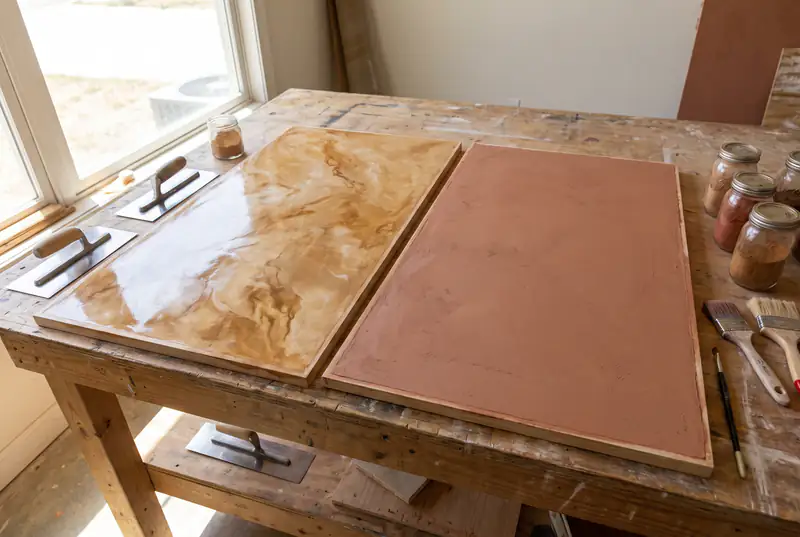
Somewhere between the moodboard and the quote, every villa owner in Bali hits the same fork: the designer wants Venetian plaster, the budget wants paint, and the price gap — roughly 650,000–1,100,000 rupiah per m² against 95,000–150,000 — looks absurd until you understand what each number actually buys. We apply both finishes every month, from Seminyak hotel lobbies to Berawa rentals, so here’s the comparison with the sales pitch removed: real costs over ten years, how each behaves in tropical humidity, and where each one genuinely belongs.
The upfront cost gap — and the ten-year math
Venetian plaster is expensive for honest reasons: imported lime materials (we work with San Marco and Kerakoll systems), 4–7 layers applied by hand, and a craftsman whose burnishing skill took years to build. Premium paint — a Dulux, Jotun or Nippon system with primer and two coats over a properly skimmed wall — is cheap for equally honest reasons: industrial product, fast application. But upfront price is the wrong lens for a wall you’ll live with for a decade. Paint in Bali’s climate needs touch-ups roughly every 2–3 years and a full repaint around year 5–7; scuffs, wipe marks and humidity staining arrive on schedule. Burnished lime needs essentially nothing beyond an occasional wax refresh. Over ten years, a 20 m² feature wall costs roughly IDR 13–18 M in Venetian plaster once, versus IDR 7–11 M in paint applied, repaired and reapplied — still cheaper, but no longer ten times cheaper. Across 300 m² of villa walls, though, the same math swings hard back to paint. Scale decides.
Look and depth: why photos don’t settle it
Paint gives you one flat, uniform colour — which is exactly what you want on 80% of surfaces. Venetian plaster gives you depth: multiple translucent layers of pigmented lime, compressed and polished until light moves inside the surface rather than bouncing off it. A grey painted wall is grey; a grey marmorino wall shifts from warm to cool as the sun crosses it, which is why photographers love it and why no photo quite captures it. The honest test is physical: we bring sample boards to the site, because the same finish reads differently under Ubud jungle light than under Nusa Dua glare. Before committing either way, look at real walls — our gallery has both finishes shot in Bali villas, not showroom lighting.
Humidity: how each finish lives through a Bali wet season
This is where the comparison stops being cosmetic. Genuine Venetian plaster is lime: vapour-open, mineral, naturally alkaline. Moisture that gets into the wall — and in Bali, it gets in — can migrate out through the finish instead of being trapped behind it, and the high pH makes the surface hostile to mould. Latex and acrylic paints work the opposite way: they form a film. A good film on a dry wall is fine; the same film on a wall taking moisture from behind blisters, bubbles and peels, which is the story of half the flaking facades you see by March. Indoors, painted bathroom ceilings grow black mould spots while lime-plastered ones stay clean. None of this makes paint wrong — modern anti-fungal formulations from Jotun and Nippon have improved dramatically — but on chronically damp walls, lime systems fail slower and more gracefully. If your walls already show cracks or damp patches, fix the cause first; our guide on why walls crack in Bali covers the diagnosis, because neither finish survives an unsolved moisture problem.
Maintenance and repair: opposite philosophies
Paint’s superpower is the touch-up: keep the tin, and any scuff disappears in ten minutes — accept that annual touch-ups and periodic repaints are simply part of owning painted walls in the tropics. Venetian plaster inverts the deal: you cannot spot-repair a burnished panel invisibly, because the polish and layered colour can’t be matched in a patch — a damaged wall gets re-finished corner to corner. In exchange, it barely ever needs it. Burnished lime is hard, scrubbable and doesn’t scuff; hotel corridors we finished seven years ago still haven’t been touched. So the real question isn’t “which is easier to maintain” but “which failure mode suits you”: constant small upkeep, or rare expensive repair. For rental villas with rotating guests and hard use, paint’s cheap fixability usually wins. For an owner-occupied living room, the plaster’s set-and-forget durability does.
Where Venetian plaster earns its price
After hundreds of walls, our short list: feature walls where one surface carries the room; living and dining rooms with strong natural light that flat paint wastes; bedroom headboard walls, where texture reads at close range; bathrooms and powder rooms, where lime’s mould-resistance is functional, not just pretty; and commercial first impressions — the boutique-hotel lobbies and restaurant walls of Seminyak and Canggu, where the finish is part of the brand and photographs sell rooms. On these surfaces the cost per m² is high but the area is small, so the cheque stays reasonable — a 15 m² headboard wall in travertino runs IDR 10–15 M. Full options and finishes are on our decorative plaster page.
Where paint is the right answer
Everywhere else — and we say that as the people selling the expensive option. Bedrooms, corridors, kitchens, ceilings, garages, staff rooms, and honestly the whole of any long-term rental: paint them. A well-executed paint system over properly skimmed walls — primer plus two coats, not the one-coat “borongan special” — looks crisp, costs a fraction, and repairs in minutes when a tenant’s suitcase scrapes the corridor. Budget-conscious builds should put money into surface preparation rather than exotic finishes: a IDR 95,000/m² paint job over a flat, well-skimmed wall beats a IDR 750,000/m² Venetian wall applied over waves. And if you’re allocating a whole-villa finishing budget, our 2026 cost guide breaks down every layer so you can see exactly where each million rupiah goes.
Side by side: the decision table
| Criterion | Venetian plaster (lime) | Premium paint system |
|---|---|---|
| Upfront cost per m² | IDR 650,000–1,100,000 | IDR 95,000–150,000 |
| Lifespan before re-do | 7–10+ years | Touch-ups 2–3 yrs, repaint 5–7 yrs |
| Look | Depth, movement, changes with light | Uniform flat colour |
| Wet-season behaviour | Breathes; mould-resistant | Film can blister on damp walls |
| Spot repair | No — re-finish the panel | Yes — ten-minute touch-up |
| Application time, 20 m² wall | 4–6 days, skilled applicator | 1–2 days |
| Best use | Feature walls, wet rooms, lobbies | Whole-house coverage, rentals |
Read the table as a matching exercise, not a scorecard. Every row where Venetian plaster wins — depth, humidity behaviour, lifespan — matters most on a small number of high-visibility or high-moisture walls. Every row where paint wins — price, speed, spot repair — matters most at whole-building scale. That’s why the two finishes coexist happily in almost every project we hand over, from a four-bedroom Canggu villa to a Nusa Dua guesthouse: the argument was never either/or.
Our honest verdict
Ignore “which is better” — the finishes aren’t competing for the same walls. The pattern that works, villa after villa: paint 85–90% of the surfaces with a proper three-coat system, then spend the Venetian budget on the two or three walls your eyes actually rest on — the living room, the headboard, the wall behind the pool bale. You get the durability and depth where they’re seen, the easy maintenance where they’re not, and a total finishing bill that doesn’t frighten anyone. That’s what we’d do with our own money, and it’s usually what we quote first.